Watercare's Central Interceptor
Meet the photographer - Simon Runting
With over 40 years' experience as a documentary photographer Simon Runting immortalises moments, showcasing the people, the machinery, the scale, and the unseen world beneath out city. This seven-year project will shape Auckland for generations to come.
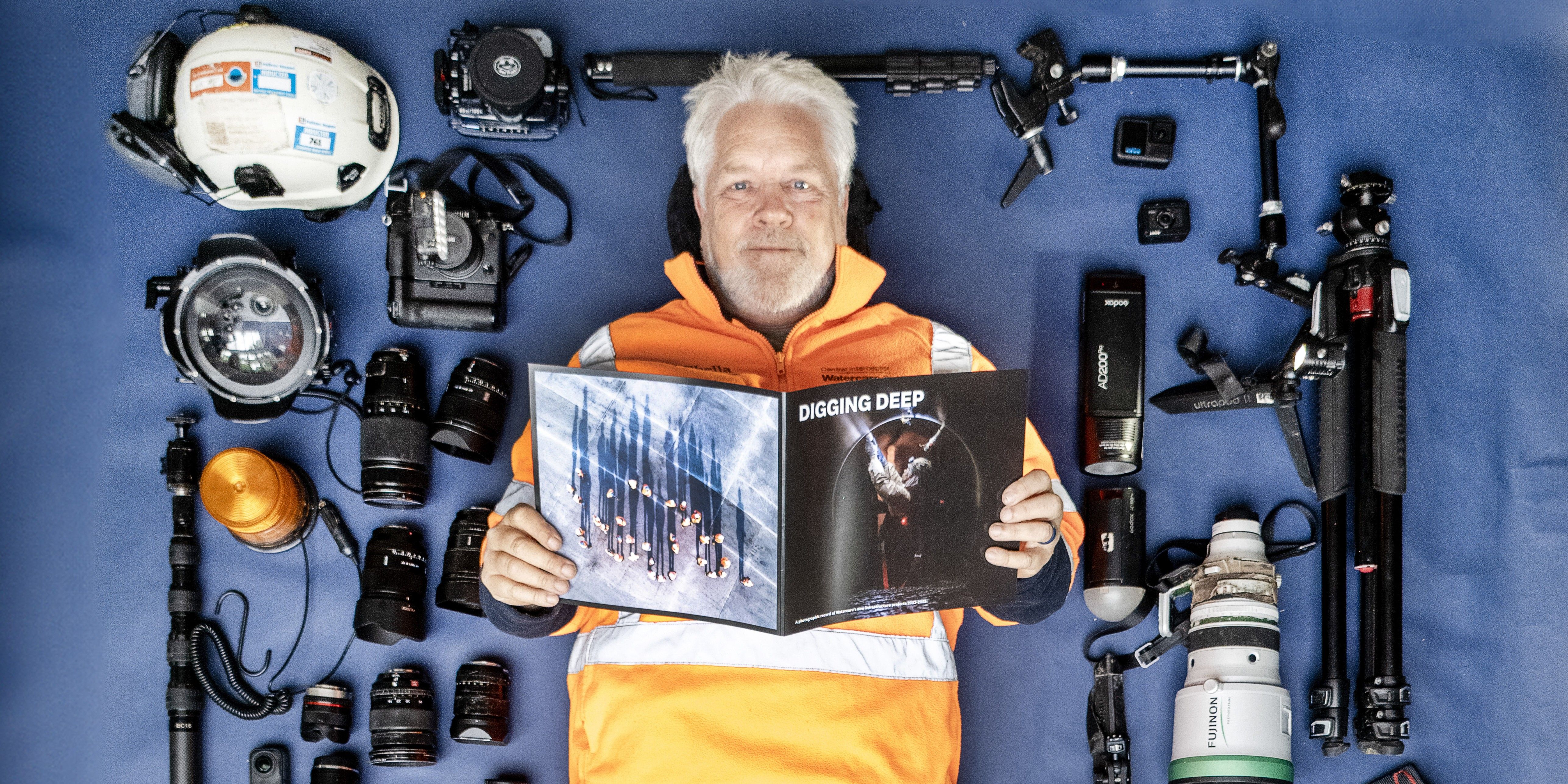
Auckland’s largest unseen infrastructure project, seen through the eye of one of the country’s most renowned photographers
Beneath Auckland’s streets, far below the traffic, cafés and harbour views, another city has been taking shape - one of tunnels, shafts, cranes, concrete, people and light. Photographer Simon Runting has spent years documenting that hidden world, capturing the scale and humanity of Watercare’s Central Interceptor as it moves from engineering project to public legacy.
On a sunny day in 2015, photographer Simon Runting donned his high-vis safety gear and a life jacket and climbed aboard a barge heading out on the Manukau Harbour.
Around him, a team of engineers used specialised equipment to bore holes in the seabed and bring up geological samples and Simon captured the excursion, snapping shots of the process, the people and the equipment.
It was his first assignment for the Central Interceptor, New Zealand’s biggest ever wastewater project, which the award-winning photographer has documented since that first harbour trip.
“I’ve been shooting the project the whole way through, including the first dawn blessing at the Māngere Wastewater Treatment Plant before the construction work began. It’s been an absolute privilege to record it all.”
Capturing nature has always been a passion of Simon's and one of his favourite haunts is the Manukau Harbour due to the rich ecology of the area. When it came time to memorialise this transformational project that started at Māngere and traversed the city, he was a natural choice.
Simon has covered every project milestone, taking more than 23,000 photos to record the construction of the mammoth 16.2-kilometre, 4.5-metre-diameter wastewater tunnel that runs from Point Erin in Herne Bay to the Māngere Wastewater Treatment Plant at depths of between 15 and 110 metres under the city. The southern half of the tunnel has been live since early 2025 and the full tunnel will go live in late July.
Simon’s photos have been used to create two Watercare Central Interceptor coffee books and his photos grace the walls of tunnelling company Ghella’s offices in Rome and contractor Jacobs’ office in Boston.
He has curated a selection of his photos to represent the project for an exhibition that is part of the Auckland Festival of Photography, which runs from 29 May to 14 June.
Thirty of the photos are displayed on the hoardings around the Central Interceptor site at Point Erin and the full gallery is available on the Watercare website.
He says the project was visually arresting from the start.
“When the very first sections of the tunnel were put in place, they were bright blue and with everybody in high-viz orange and the lighting underground, it created an amazing scene.”
Although it was tough to narrow down the selection, Simon enjoyed the chance to show different aspects of his work.
“The gallery allowed me to include some pictures that weren’t necessarily newsworthy but were personal to me. Although this work is documentary, I also shoot from an engineering point of view and an artistic point of view. I’m always looking for pictures.”
Through the image selection, it’s clear that Simon approaches his work with an creative, human eye – illustrating the relationship between people and infrastructure.
“With the people, the equipment and the dramatic underground lighting I tried to convey the working conditions of everyday life on the project. It was a messy job at times. Hats off to the people who did it every day and night.”
Although he’s taken many spectacular shots of the construction in progress and the giant tunnel boring machine, Hiwa-i-te-Rangi, he says most of his work has been about the people.
“Winning their trust has been absolutely essential for this job. At first, they were reluctant to give me access, but the Ghella-Abergeldie Joint Venture [which delivered the project for Watercare] started printing some of my early photos and putting them up around the work areas so people could see what I was shooting and see themselves working. That really helped.”
Simon did a two-day project induction and a two-day underground induction, along with confined space training, working at height training and three-monthly refresher training on the rebreather units everyone must have on their person while underground, to make sure he had full access to the project.
“I’ve had more access and been to more parts of the project than almost anyone else. Some of the engineers haven’t been where I’ve been.”
He’s gone above and beyond – or, more accurately, below and beyond – to get the shots, lugging his 15kg or so of gear up and down ladders and squeezing into small spaces.
“You have to have a minimum of two or three camera bodies with you in the tunnel because you can’t change lenses underground. There’s too much dust. And you’ve got to be pretty fit, because sometimes you’d be climbing up 15 flights of ladders. I’ve enjoyed every minute of it.”
It’s impossible to choose a favourite image from so many, but Simon found some opportunities especially memorable.
“One that stands out was the buggy lighting up the yellow tunnel for the final inspection drive-through. It immediately reminded me of the opening of a Bond movie and was so unexpected as we went from near total darkness 70 metres underground to a beautifully lit scene that lasted just seconds.”
For Aucklanders, the exhibition offers a rare chance to see the city from an angle few will ever experience - not from a lookout or waterfront path, but from deep inside the infrastructure that quietly supports daily life.
“I hope the photos will provide insight into what was a massive undertaking the Central Interceptor was for Watercare and the GAJV team as it will never be seen again once it is in operation.”